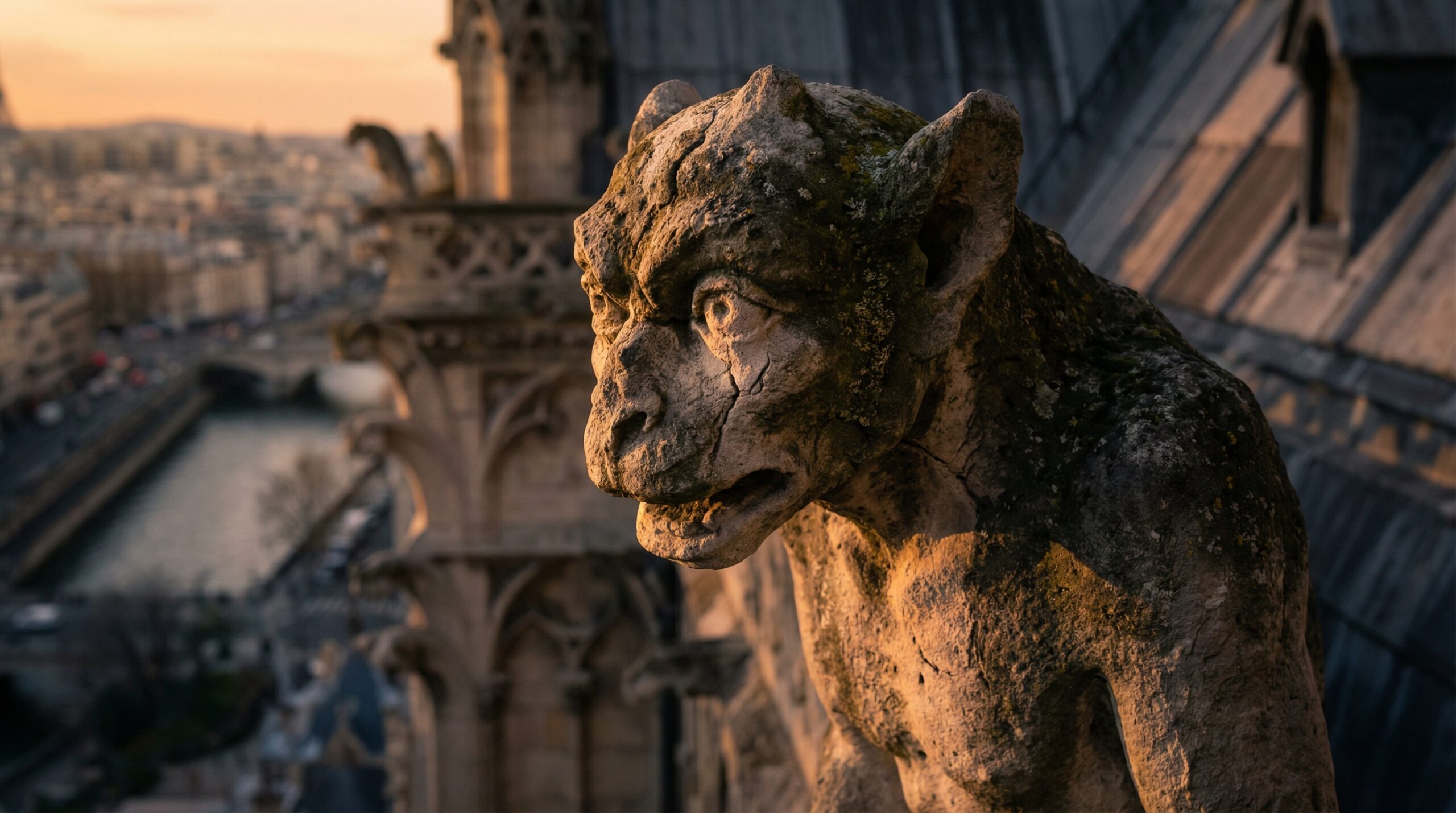
When looking up at the towers of Notre Dame, you see the famous silhouettes of strange creatures that resemble demons, birds, and hybrids. Although most people call these “gargoyles,” that label is technically incorrect. Understanding the architectural difference between these monsters completely changes how you view the cathedral.
The Gargoyle: The Medieval Plumber
A gargoyle is essentially a functional waterspout. Because the word originates from the French gargouille (meaning “throat”), its purpose is entirely practical.
- Function: It acts as a drainage spout.
- Location: These figures stick out significantly from the walls.
- Purpose: When rain falls, water runs off the roof. If this water flowed directly down the stone walls, it would erode the mortar over time. Consequently, the gargoyle catches the water and “vomits” it far away from the building.
While designers made them scary to ward off evil, their primary role is engineering. You can find these functional spouts all over the lower levels and along the flying buttresses.
The Chimera: The Moody Decoration
Unlike the gargoyle, a chimera (or chimère) does not carry water. Instead, it simply sits on the railing as a stationary figure.
- Function: These serve as pure decoration.
- Location: You will find them sitting on the balustrade connecting the two towers.
- Purpose: They exist to create a mysterious atmosphere and symbolically protect the church from demons.
Interestingly, the most famous statues at Notre Dame are actually chimeras rather than gargoyles.
Meeting “Le Stryge”
The most legendary monster on the cathedral is a chimera known as “Le Stryge” (The Vampire). Sitting on the corner of the North Tower, he features horns and wings while resting his head in his hands.
Because he overlooks the city with a bored, cynical expression, photographers have turned him into an icon of Paris. He is now frequently used as a symbol for the city itself.
The 19th-Century Secret
It is a little-known secret that these chimeras are not actually from the Middle Ages. Weather and vandalism destroyed or forced the removal of the original medieval statues centuries ago. Consequently, when architect Eugène Viollet-le-Duc restored the cathedral in the 1840s, he added the modern chimeras.
Inspired by Victor Hugo’s novel The Hunchback of Notre Dame, Viollet-le-Duc wanted to make the building appear more “Gothic” and romantic. He designed the Stryge and his companions as a 19th-century fantasy of what the Middle Ages looked like.
Summary Checklist
- Sticking out far from the wall? That is a Gargoyle.
- Sitting quietly on a rail? That is a Chimera.
- Vomiting rainwater? Definitely a Gargoyle.
- Looking moody and eternal? That is a Chimera.
Leave a Reply