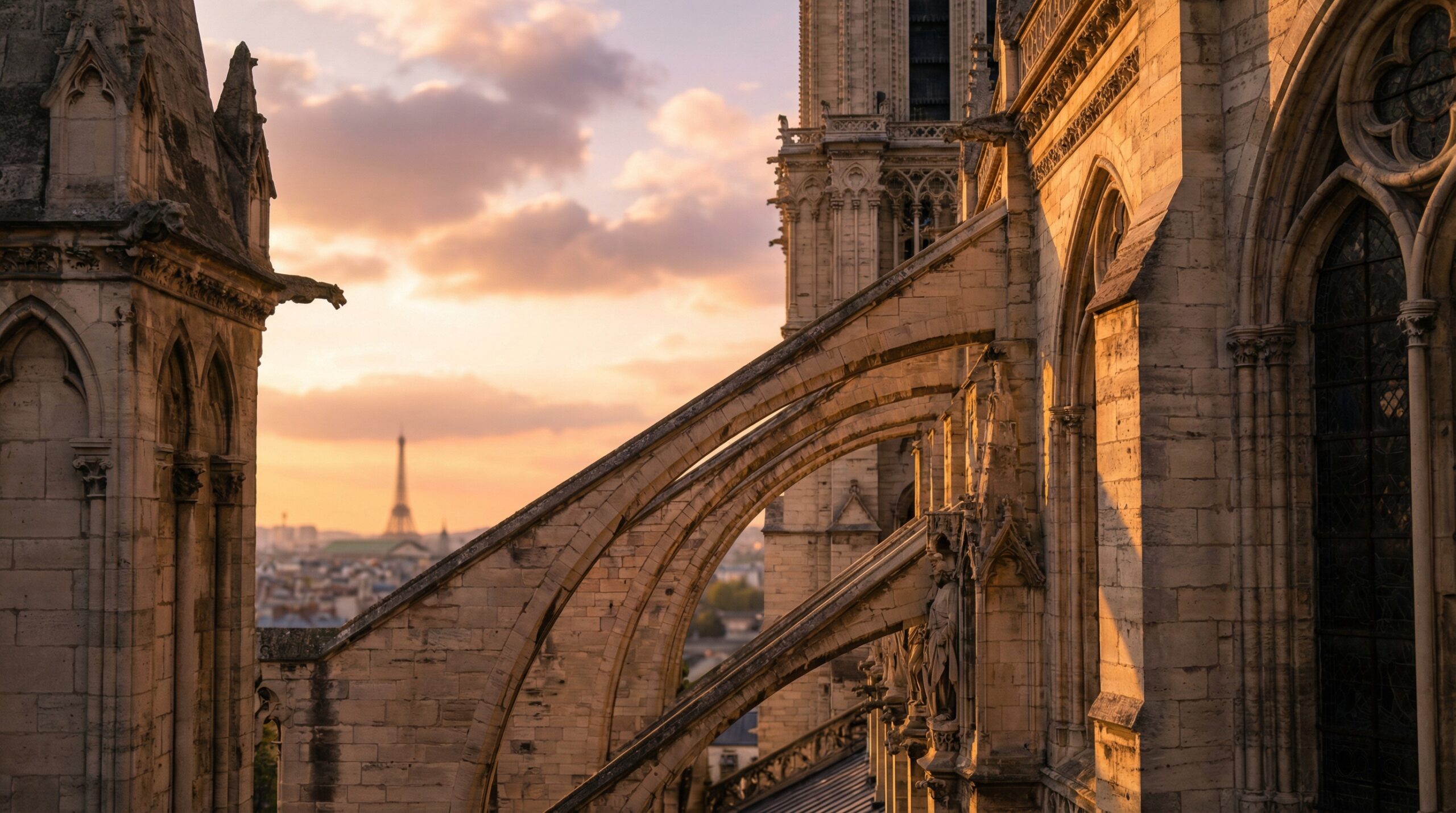
When you view Notre Dame from the river, the cathedral resembles a massive stone skeleton. You will notice giant stone ribs curving from the main walls down to the ground; these are known as “flying buttresses.” Far from being just decorative, they are the defining structural feature of the cathedral. Without them, the entire building would simply collapse.
The Problem: Gravity vs Light
During the 12th century, architects faced a major dilemma because everyone wanted taller churches and more light. To achieve more light, you need large windows; however, to have large windows, you must remove stone from the walls.
If you build a tall wall and cut holes in it for windows, the structure becomes dangerously weak. The heavy stone roof creates a constant outward pressure called “thrust.” If this force isn’t countered, the walls will eventually blow outward, causing the roof to fall in.
The Solution: The External Prop
Think of a person leaning against a wall to keep from falling over; they stick their arm out to prop themselves up. In this analogy, the buttress is that arm.
While Romanesque churches relied on incredibly thick walls to handle weight, Gothic architects realized they could move the support to the outside. By building a stone pillar a few meters away from the wall and connecting it with an arch, they created a support that “flies” through the air.
How the physics works:
- Down and Out: The heavy roof pushes against the upper walls.
- The Catch: The flying buttress catches that outward push.
- The Curve: Energy travels down the curve of the stone arch.
- The Ground: The force is transferred into a heavy outer pier and safely into the earth.
Aesthetic Benefits
Because the buttresses were doing the “heavy lifting” on the outside, architects were free to transform the interior. They stripped the walls down to thin pillars and filled the massive gaps with stained glass. Consequently, this is why Notre Dame feels like a palace of glass rather than a dark cave of stone.
Evolution Over Time
Interestingly, the buttresses at Notre Dame were not all part of the original 12th-century plan. As construction went higher, the builders noticed the walls were moving and were forced to add reinforcements.
By the 14th century, Jean Ravy added the spectacular flying buttresses around the choir at the back of the church. These are 15 meters long and remarkably elegant. Furthermore, they serve a dual purpose: the architects carved gutters into the tops to drain rainwater away from the roof, protecting the masonry from erosion.
Summary for your Visit
Next time you visit, don’t just stay at the front door. Walk to the back of the cathedral to see the 15-meter arches. You aren’t just looking at art; you are looking at a medieval engineering breakthrough that changed architecture forever.
Leave a Reply