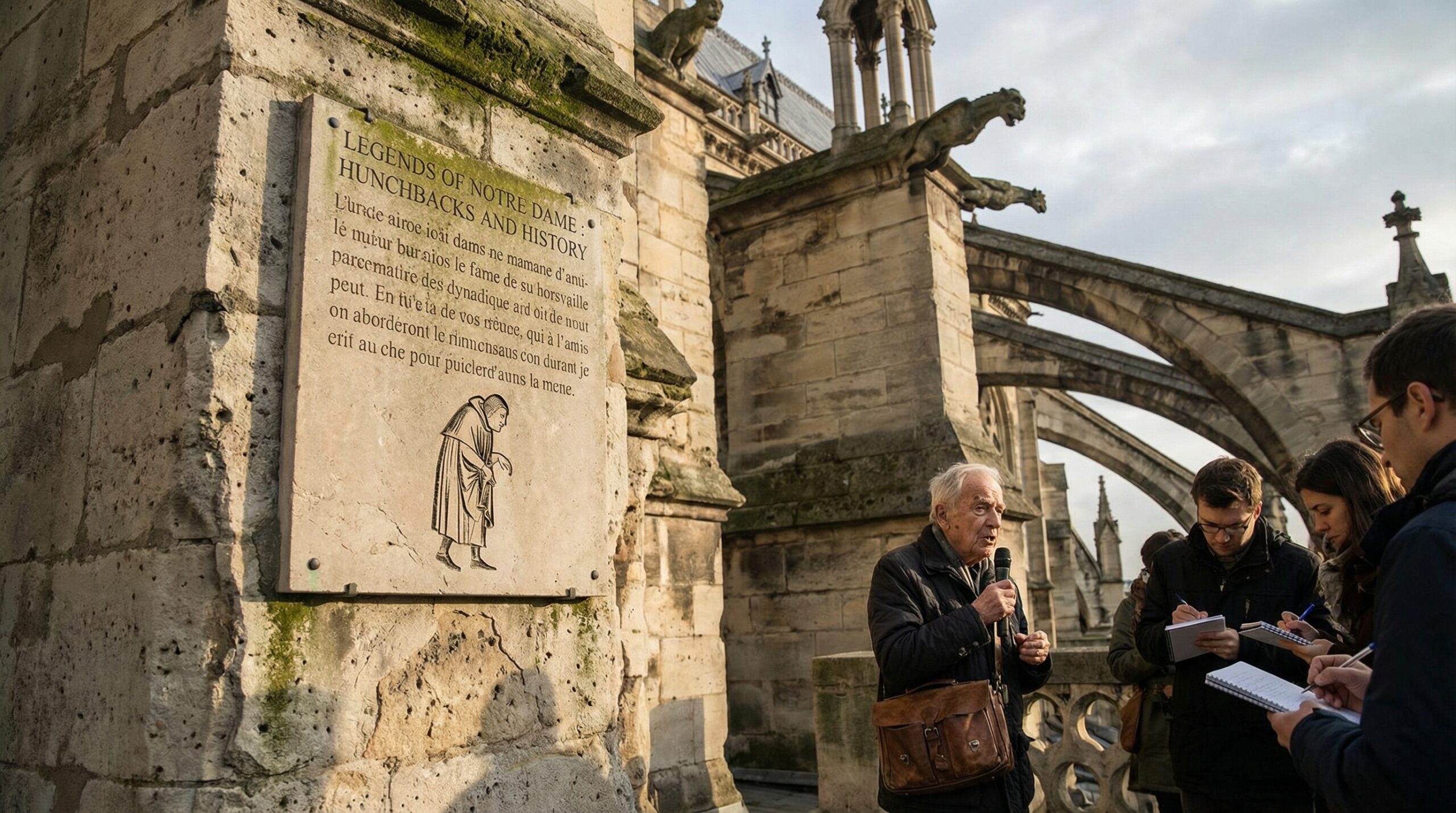
A cathedral is much more than a simple pile of rocks; rather, it is a vessel for stories. Specifically, Notre Dame de Paris holds the collective memory of a nation and appears constantly in literature, movies, and paintings. To truly understand Paris, one must understand the deep meaning behind this building.
Victor Hugo and the Hunchback
Interestingly, we owe the existence of the modern cathedral to a single book. In the early 1800s, Notre Dame was falling apart and suffered from extreme neglect. Consequently, city officials even considered tearing the structure down entirely.
However, in 1831, Victor Hugo wrote The Hunchback of Notre Dame. The novel became a massive hit, but the true main character was not Quasimodo; it was the cathedral itself. Because Hugo wrote pages describing its beauty, the public fell in love with the building again and demanded its restoration. This led to a massive renovation project by Eugène Viollet-le-Duc, proving that literature literally saved the architecture.
The Legend of Point Zero (Point Zéro)
If you walk to the square in front of the main entrance, known as the Parvis Notre-Dame, you should look at the ground. There, you will find a small brass star embedded in the concrete.
This marker is “Point Zero,” the official center of Paris. Whenever you see a road sign saying “Paris 200 km,” it refers to the distance to this exact spot. According to local legend, if you step on the star, you are destined to return to Paris one day. As a result, travelers from all over the world often spin on it for good luck.
The Giant Bells of the South Tower
The bells of Notre Dame each have unique names, but the most famous is Emmanuel. This massive bell weighs 13 tons and is located in the South Tower. Notably, Emmanuel is the only bell that survived the French Revolution because the revolutionaries melted the others to make cannons. Because it only rings on major occasions—such as Christmas or the end of a war—hearing it is a rare and powerful event.
The Patron Saints and Iconography
While the cathedral is named for Mary, it also honors Saint Geneviève and Saint Denis. When exploring the facade, you will see the statue of Saint Denis holding his own head. Legend says he was decapitated by Romans on Montmartre and walked six kilometers while preaching a sermon. Consequently, he remains a key figure in the cathedral’s iconography.
The Mystery of the Devil’s Doors
There is a famous legend regarding the ironwork on the side doors. A young blacksmith named Biscornet was tasked with creating the hinges, but the design was allegedly too complex. According to myth, he sold his soul to the devil for help. When the doors were finished, they remained locked tight until a priest sprinkled them with holy water. Because Biscornet died shortly after, the myth persists today.
A Symbol of Stability
Ultimately, Notre Dame is where France chooses to celebrate and mourn. It serves as a symbol of stability because while kings came and went and empires fell, the cathedral remained. By visiting, you are stepping onto Point Zero and connecting with the bells that Hugo once wrote about. You are becoming part of the legend.
Leave a Reply