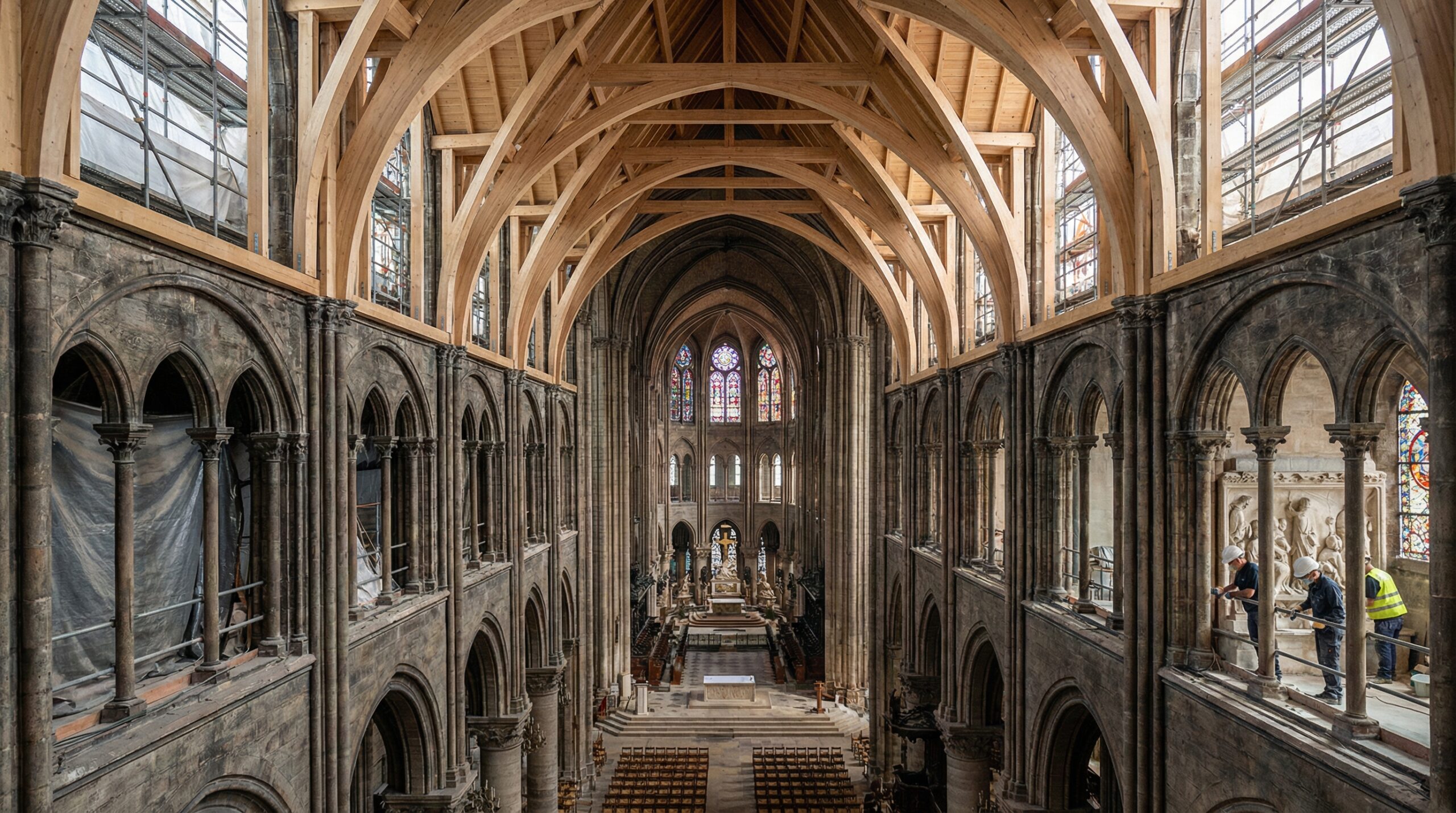
If you visited Notre Dame before 2019, you likely remember a dark and somber space. At that time, the stone appeared grey, the corners were filled with shadows, and the atmosphere felt heavy with centuries of candle soot and city pollution.
However, that version of the cathedral is gone. Because the fire of 2019 forced a complete cleaning of the interior, the difference you see when walking inside today is shocking. The stone has been restored to a creamy blonde, allowing light to reflect off the walls. As a result, the cathedral feels twice as large and infinitely brighter than before.
The Nave and the Cleaning Process
The main hall, known as the nave, stretches from the entrance to the crossing with a ceiling that soars 33 meters (108 feet) above your head. Before the restoration, the intricate details of the vaulted ceiling were difficult to see; now, you can actually count the individual stones.
To achieve this, experts applied a specialized latex paste to the walls. When the paste was peeled off, it effectively lifted away decades of dirt and lead dust. Consequently, the columns, arches, and ceiling ribs now glow with a uniform, warm limestone hue.
Understanding the Layout
Navigating the space is much easier once you understand the floor plan:
- The Narthex: The initial entrance area located under the towers.
- The Nave: The long central aisle intended for the congregation.
- The Transept: The shorter arms that create the cathedral’s cross shape.
- The Choir: The sacred area housing the altar and wooden stalls.
- The Ambulatory: The curved walkway situated behind the altar.
Masterpiece of Engineering: The Vaulting
When you look up, you are viewing a masterpiece of medieval engineering known as six-part ribbed vaults. This design features six stone ribs meeting at a single central point.
During the fire, the collapsing spire unfortunately punched holes through these vaults. Although the gaps have been fixed, you can still see where the repairs happened. Because the new stone is slightly lighter than the original medieval stone, the history of the repair remains visible—a deliberate choice by the masons to honor the building’s journey.
Modern Lighting and the Sense of Space
The new artificial lighting system is designed to be subtle rather than intrusive. In the past, harsh spotlights often created distracting glare; however, the new system highlights architectural lines without blinding visitors.
Ultimately, the biggest change is the newfound sense of volume. Instead of entering a dark cave, you are now entering a “palace of light” where the pale walls make the entire space feel expansive.
Leave a Reply