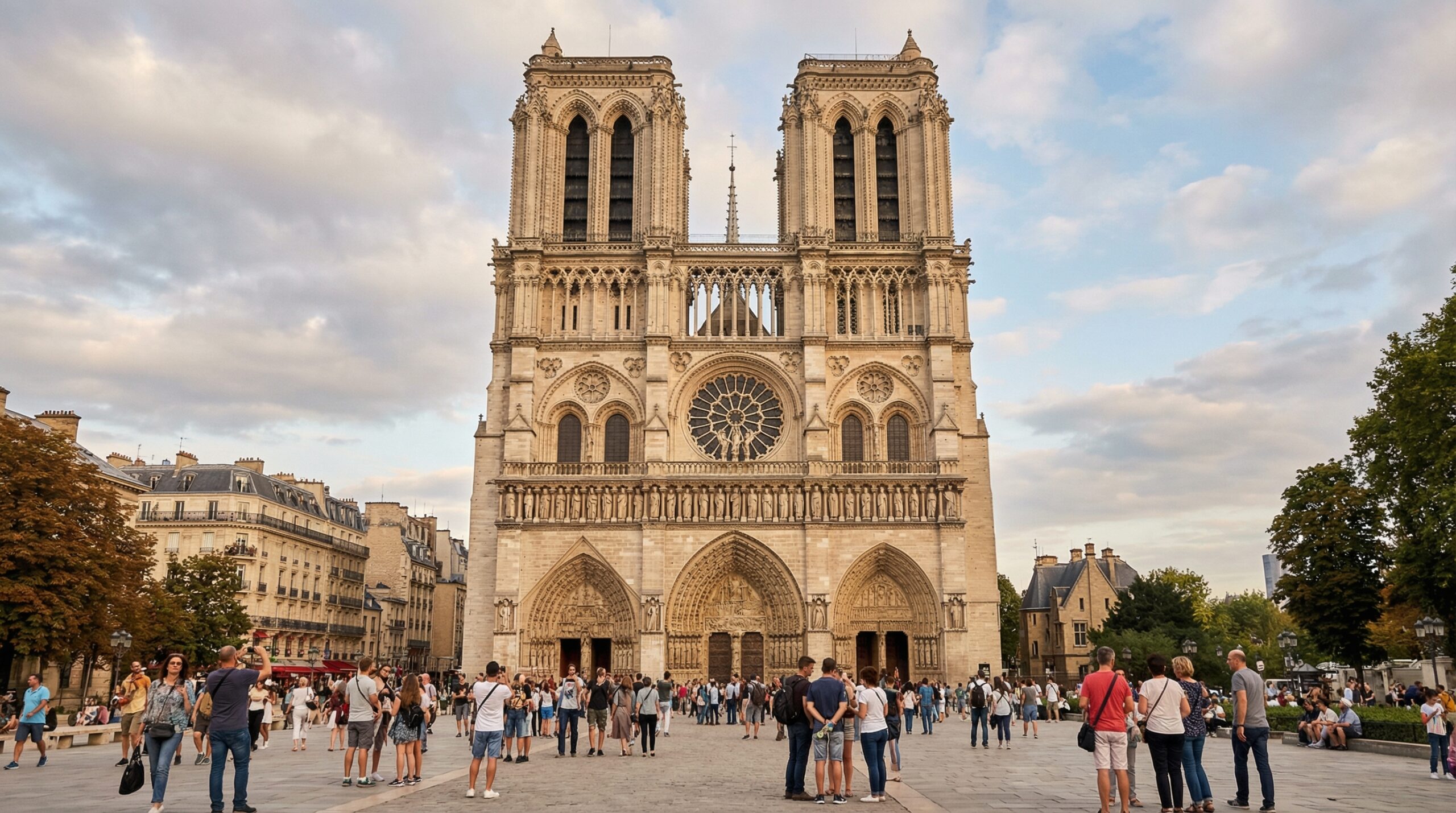
Notre Dame and the Palace of Versailles serve as the two distinct bookends of French history. While one represents the spiritual depth of the Middle Ages, the other embodies the absolute power of the Monarchy. Consequently, comparing these two “houses”—one built for God and the other for a King—helps us understand how France transformed over five centuries.
Diverging Architectural Styles
The styles of these landmarks could not be more different. Notre Dame, begun in 1163, is a masterpiece of Gothic architecture. Because it utilizes pointed arches and flying buttresses, the structure emphasizes verticality and reaches toward the heavens. Its rough, ancient stone creates a mysterious and spiritual atmosphere.
In contrast, Versailles (1661) represents Baroque and Classical architecture. Rather than reaching upward, it spreads horizontally across the landscape. By utilizing gold, mirrors, and strict symmetry, the palace project a feeling of intimidation and absolute power.
Purpose and Location
Furthermore, the two sites served entirely different social functions:
- Notre Dame: Built in the heart of Paris, it was designed as a community hub for the people. Consequently, anyone could enter, ranging from the poorest beggars to the wealthiest merchants.
- Versailles: King Louis XIV built this estate specifically to escape the people of Paris and control the nobility. It was an exclusive stage designed to showcase royal authority.
Raw Materials and Visible Engineering
The beauty of Notre Dame stems from its limestone, lead, and oak wood structure. Its engineering is “honest,” meaning you can clearly see the ribs and buttresses holding the building together.
Versailles, however, prioritizes decoration over structure by using gold leaf, velvet, and marble. For example, the Hall of Mirrors is designed to trick the eye through theatrical reflections, hiding the brick and mortar behind the walls.
Gardens and Nature
Even the surrounding landscapes tell a story of different philosophies.
- The Cathedral: Small, quiet gardens like Square Jean XXIII offer places for contemplation.
- The Palace: Massive gardens dominate the landscape, where the King forced nature to obey him. To achieve this, trees were cut into perfect shapes and fountains were powered by complex hydraulics.
The Visitor Experience
Ultimately, the experience of visiting these two sites is polar opposite. At Notre Dame, you tend to whisper and walk slowly while smelling incense, creating an internal, reflective experience. Conversely, Versailles is an external experience where you feel overwhelmed by walking miles through rooms filled with gold.
Summary
To truly understand France, you must see both. While Notre Dame reveals the soul of the nation, Versailles showcases its ego. Together, they explain the tensions that eventually led to the French Revolution.
Leave a Reply