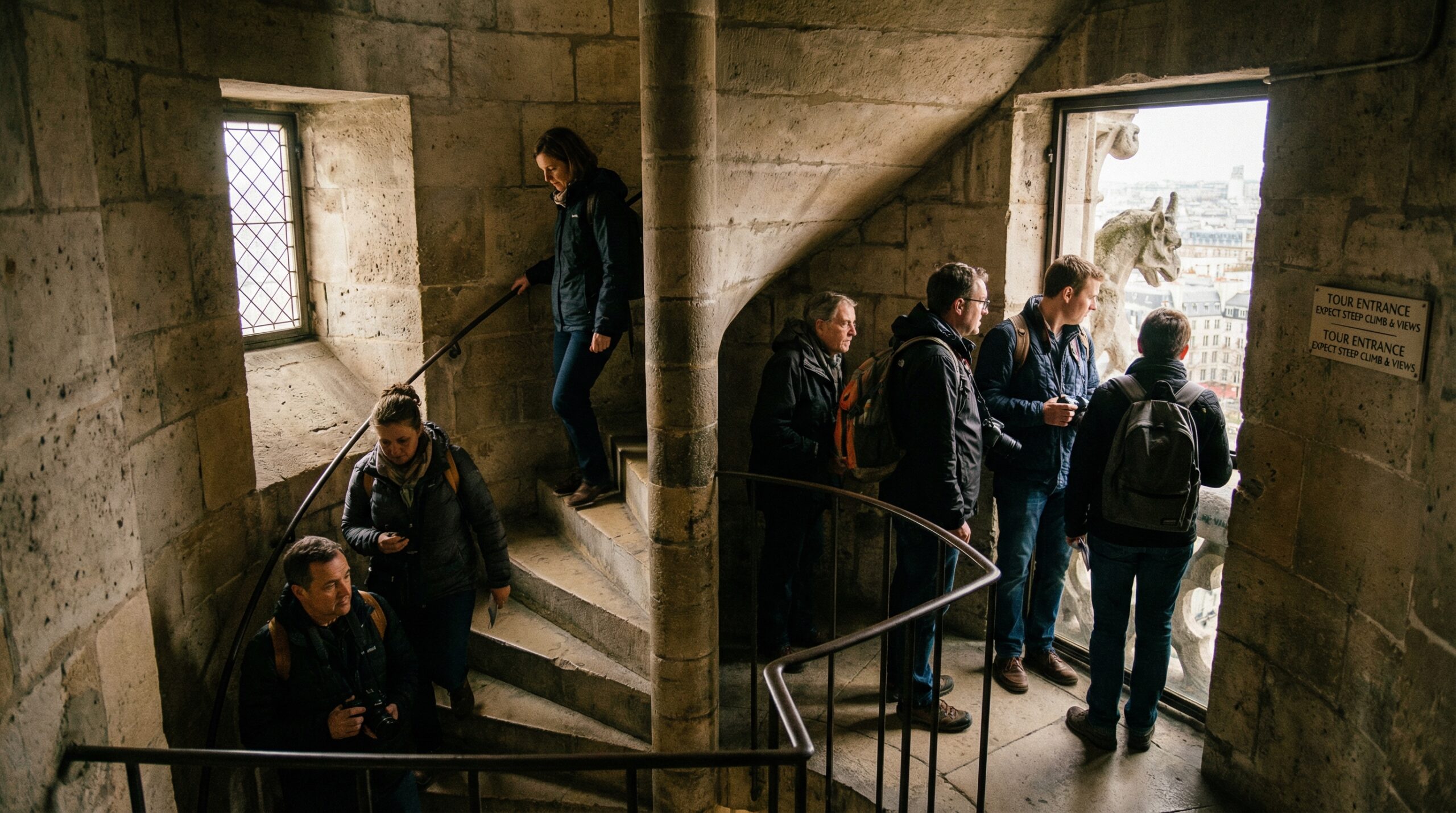
While the two towers of Notre Dame define the Paris skyline and appear identical from a distance, they are actually quite unique. If you look closely, you will notice the North Tower (on the left) is slightly wider than the South Tower (on the right). These towers remain the most popular attraction at the cathedral after the nave, as they offer a blend of history, physical exercise, and arguably the best view in the city.
Height and Structure
Standing 69 meters (226 feet) tall, these towers were among the tallest structures in Paris until the Eiffel Tower was built in 1889. The builders used Lutetian limestone, a local stone that is both durable and glows with a warm yellow-grey hue at sunset. Although architects originally intended to top these structures with sharp spires, they were never completed. Consequently, the flat-top look became the cathedral’s signature style.
The Climb
Because there are no elevators for tourists, reaching the top requires a climb:
- Steps: You must ascend approximately 387 to 400 steps depending on the specific route.
- Staircase: The journey takes place within a narrow stone spiral.
- Difficulty: The climb is moderate but requires a continuous effort.
The North and South Towers
Visitors usually enter through the North Tower, which historically served as the public entrance. In contrast, the South Tower houses the cathedral’s “voice”—the legendary bell named “Emmanuel.”
Weighing 13 tons with a 500-kilogram clapper, Emmanuel is the only bell that survived the French Revolution. While revolutionaries melted all other bells to produce cannons and coins, they spared this masterpiece. Today, Emmanuel rings only for major historical events, such as the end of World War I, the liberation of Paris in 1944, and significant religious holidays.
The Gallery of Chimeras
The primary reason many choose to climb is to access the open-air gallery connecting the two towers. This is where the famous gargoyles and chimeras reside.
During your visit, you can stand face-to-face with the “Stryge,” a famous horned creature who sits with his head in his hands. Although these iconic statues appear ancient, the architect Viollet-le-Duc actually added them during the 19th-century restoration.
The Ultimate View
From the summit, you can see all of Paris unfolding beneath you:
- West: View the Eiffel Tower and the modern skyscrapers of La Défense.
- North: See the Sacré-Cœur Basilica sitting atop its hill.
- East: Watch the Seine River as it winds away into the distance.
Ultimately, these towers serve as a bridge between the sky and the city, allowing you to see Paris exactly as Quasimodo would have seen it.
Leave a Reply