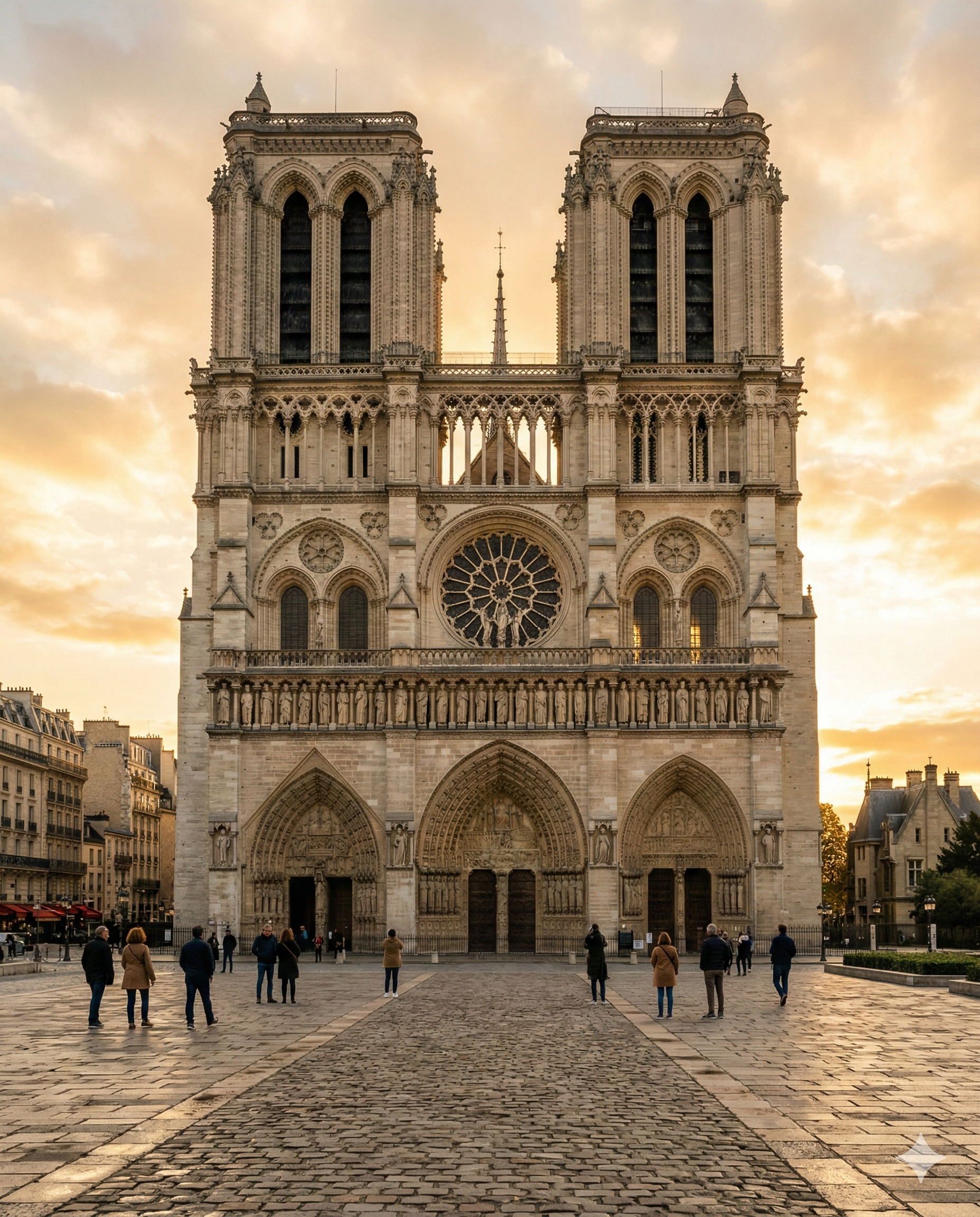
Notre Dame serves as a comprehensive textbook that teaches everything you need to know about French Gothic architecture. Before this iconic building existed, churches typically utilized the Romanesque style, which featured dark, heavy interiors with thick walls and tiny windows.
However, Notre Dame completely changed the architectural rules. Because the architects desired height and abundant light, they wanted to create a space that felt like “heaven on earth”. To achieve this vision, they invented revolutionary engineering techniques that effectively defied gravity.
The Evolution of Style
Notre Dame sits right on the edge of history as an Early Gothic structure that eventually evolved into High Gothic. Consequently, you can see this timeline reflected in the stones:
- The Choir: As the oldest part of the church, the choir uses simpler designs.
- The Nave: This main hall was built later and reflects a more refined style.
- The Transepts: These cross-sections were updated in the mid-13th century to accommodate massive windows.
Engineering the Ribbed Vault
When you look up at the ceiling, you will see a web of stone arches known as a “ribbed vault”. In older churches, the heavy barrel-shaped roofs pushed down evenly on the walls, requiring them to be incredibly thick.
In contrast, ribbed vaults channel the weight of the roof into specific columns. Since this technique freed up the walls from holding the primary weight, builders could finally cut large holes in them to allow for light.
The Necessity of Flying Buttresses
The most famous exterior features are the flying buttresses, which look like giant stone spider legs extending to the ground. While they are beautiful, they began as structural necessities. As builders made the walls higher and thinner to hold stained glass, the structure became unstable and began to lean outward.
To solve this, architects built external arches to push back against the walls. These buttresses transfer the lateral thrust of the roof down to the solid ground, making Notre Dame one of the first buildings to use this technology on such a massive scale.
The West Facade: The Three Portals
The front of the cathedral, or the West Facade, is a masterpiece of vertical and horizontal balance. At the base, you will find three portals covered in intricate statues:
- The Portal of the Last Judgment (Center): This doorway depicts the weighing of souls.
- The Portal of the Virgin (Left): This section is dedicated entirely to Mary.
- The Portal of Saint Anne (Right): As the oldest door, it actually reuses statues from an earlier church.
Summary
Ultimately, Notre Dame proves that engineering and art are inseparable. The flying buttresses exist to keep the building standing, and the stained glass exists only because the ribbed vaults made it possible. Every beautiful element within the cathedral serves a vital practical purpose.
Leave a Reply