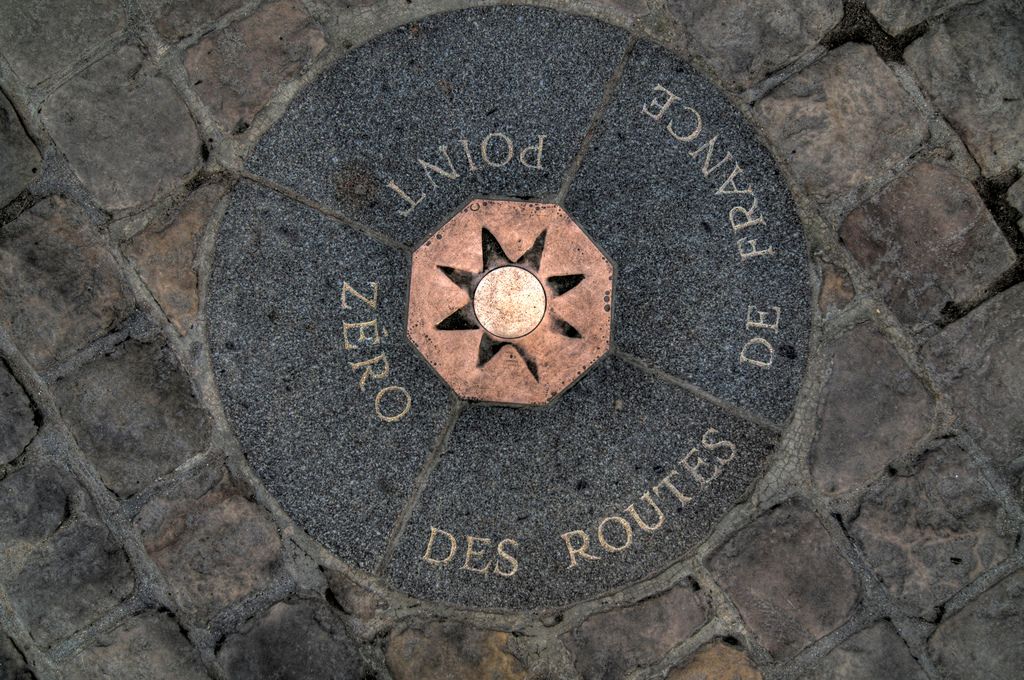
Standing in front of Notre Dame Cathedral, most visitors look up at the towers or take photos of the statues. However, by doing so, you might miss one of the most important historical markers in the entire city that is situated right under your feet. This marker is known as “Point Zéro des Routes de France” (Point Zero of the Roads of France). Although it is merely a small brass plate embedded in the concrete, it holds immense geographical and symbolic significance.
What is Point Zero?
This humble marker serves as the official geographic center of Paris. Furthermore, it is the specific point from which all distances in France are measured. For example, if a highway sign in Nice indicates that Paris is 930 km away, it does not refer to the city limits; instead, it indicates the distance to this exact piece of metal. Consequently, it acts as the anchor for the entire country.
How to Find the Marker
Because Point Zero is small and often covered by the feet of crowds, finding it can be tricky. To locate it, you should follow these steps:
- Navigate to the Square: Go to the Place du Parvis Notre-Dame, the large square in front of the cathedral.
- Position Yourself: Stand facing the main entrance of the building.
- Walk Forward: Move about 20 meters (65 feet) away from the central door.
- Look Down: Look for an octagonal brass plate featuring a wind rose design in the center.
- Read the Inscription: The edges of the plate read: “POINT ZÉRO DES ROUTES DE FRANCE”.
A History of Power and Penance
This location has remained significant for centuries. Before the current brass plate was installed in 1924, a post known as the “Scale of Justice” stood on this spot. During the Middle Ages, criminals were forced to kneel and do penance here before the cathedral. Today, the meaning of the spot has transformed from a place of judgment into a place of connection that represents the centralization of France.
The Traveler’s Legend
Over several decades, a local superstition has developed around the marker. The legend suggests that if you step on Point Zero, you are destined to return to Paris one day. As a result, you will often see couples kissing on it or backpackers spinning in circles on the plate. Some people even leave coins as part of a ritual to ensure their first trip to the city will not be their last.
Symbolism of the Center
Paris is a city defined by symbols; while the Eiffel Tower represents engineering and the Louvre represents art, Point Zero represents authority. For centuries, the King and the Church intended to show that power radiated from this island. By placing the zero point here, they effectively declared that Notre Dame was the center of the world.
Practical Tips for Visitors
- Go Early: Because the square becomes crowded by 10:00 AM, try to visit at 8:00 AM for a clear photo.
- Look for the Shine: The brass is polished by millions of shoes and typically shines brighter than the surrounding grey stones.
- Be Courteous: Take your photo quickly and move so others can enjoy the spot.
The next time you visit the cathedral, remember to look down, as you are standing on the literal bullseye of France.


Leave a Reply