Gemini said
While you might recognize the iconic silhouette of its towers or recall the tragic fire, Notre Dame remains a sanctuary of secrets that most tourists overlook. The cathedral functions as a complex historical machine, where every stone and relic tells a unique story.
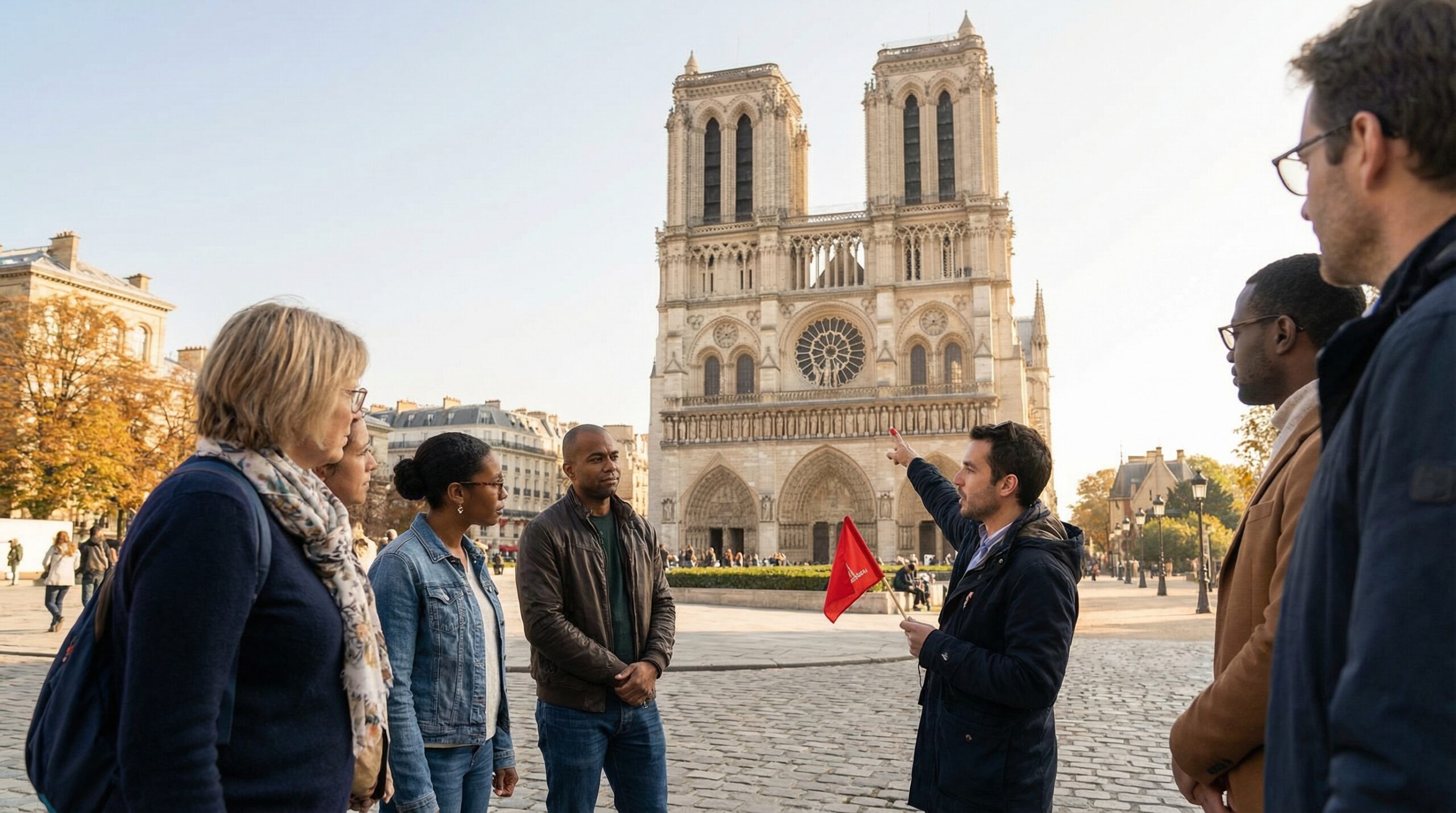
Here are 10 essential facts to transform you into the resident expert of your travel group.
1. The Literal Center of France
Did you know that all distances in France are measured from this exact spot? A small brass star is embedded in the pavement of the square in front of the cathedral. This marker represents “Point Zero.” According to local legend, stepping on this star ensures you will return to Paris one day.
2. The Resilient Hives of the Sacristy
The cathedral actually hosts a thriving colony of bees on the roof of its sacristy. Since 2013, these hives have produced local honey; miraculously, they survived the 2019 blaze. While the intense smoke put the bees into a dormant state, the flames fortunately never reached their location.
3. Rebuilding “The Forest”
The original wooden roof framework earned the nickname “The Forest” because it required roughly 21 hectares of oak trees to construct. Each individual beam was carved from a single tree. Although this masterpiece burned in 2019, craftsmen have rebuilt it using the exact same amount of wood and traditional techniques.
4. The Guardian Rooster
The metal rooster atop the spire serves as more than just a decoration; it acts as a sacred vessel. It originally contained a piece of the Crown of Thorns along with relics of Saint Denis and Saint Geneviève. After being found battered but intact in the rubble, the original was moved to a museum, and a brand-new rooster now sits on the reconstructed spire.
5. Emmanuel: The Survivor Bell
The South Tower houses the cathedral’s largest bell, a 13-ton giant named Emmanuel. Because revolutionaries melted down the other bells for cannons during the French Revolution, Emmanuel stands as the only original survivor. Today, this massive bell only rings on significant historical or religious occasions.
6. The Temple of Reason
During the height of the French Revolution, religion was banned, and Notre Dame was renamed the “Temple of Reason.” For a period, the revolutionaries used the sacred interior to hold atheist festivals and even utilized the cathedral as a warehouse for wine storage.
7. Protecting the Crown of Thorns
One of Christianity’s most significant relics, the Crown of Thorns, is housed within the cathedral. King Louis IX originally purchased the wreath in 1239. During the 2019 fire, a dedicated team of firefighters formed a human chain to save this artifact from destruction.
8. An Organ with 8,000 Voices
The Great Organ is the largest in France, boasting five keyboards and nearly 8,000 pipes. While the fire did not burn the organ, the instrument was choked by toxic lead dust. Consequently, experts had to remove and clean every single pipe individually before the cathedral could reopen.
9. The 387-Step Climb
Historically, reaching the top of the towers meant navigating narrow, dizzying spiral staircases without the help of an elevator. Tourists must climb 387 steps to earn the famous view of Paris, a journey that offers a true perspective on the building’s grand scale.
10. A State-Owned Monument
Surprisingly, the Catholic Church does not own the building; the French government does. Under the 1905 law separating church and state, the government is responsible for maintenance and repairs, while the church is granted the right to use it for religious services.
Why These Facts Matter
Ultimately, these details transform an architectural landmark into a living narrative. Notre Dame is far more than a pile of stones; it is a resilient home for bees, a guardian of relics, and a witness to centuries of French history.
Leave a Reply