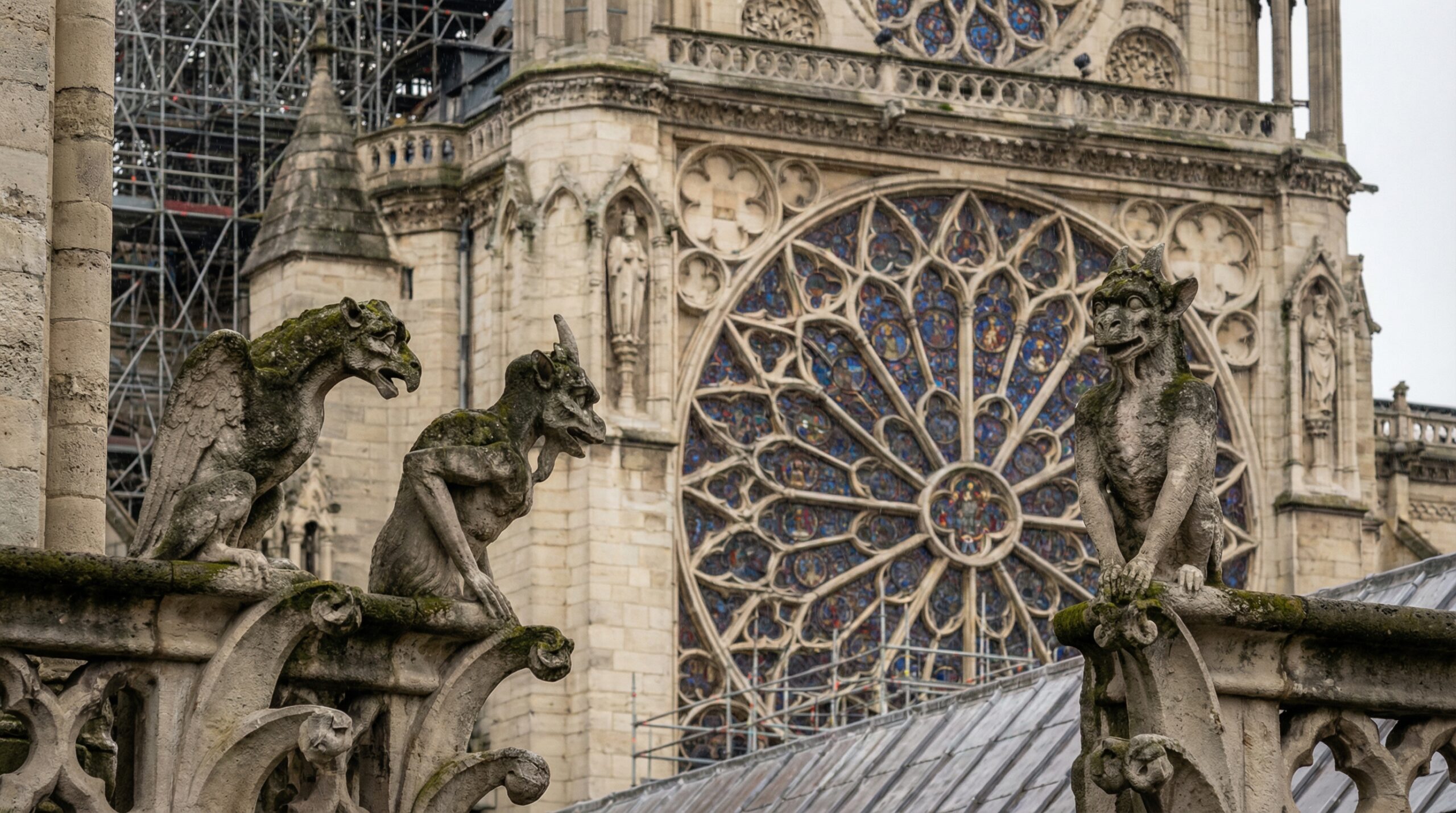
Notre-Dame serves as the textbook definition of French Gothic architecture because it is massive, intricate, and intensely vertical. The original architects intended to draw your eye upward toward heaven, and they achieved this through both engineering breakthroughs and artistic detail. Fortunately, you do not need to be an architect to appreciate the design; instead, you simply need to know what to look for.
The Flying Buttresses
If you walk around to the back of the cathedral and look at the garden side, you will see giant stone arches extending from the building to the ground. Known as flying buttresses, these structures solved a major 12th-century engineering problem. Because builders wanted high walls and massive windows, they had to manage the immense weight of stone roofs that pushed walls outward. These buttresses act like external ribs to push back, which allowed the cathedral to have walls made largely of glass rather than solid stone.
The Three Rose Windows
The cathedral features three massive, circular stained glass “rose” windows:
- West Rose: Located above the main entrance, this is the oldest window and dates to roughly 1225.
- North Rose: This window is dedicated to the Old Testament and still contains much of its original 13th-century glass.
- South Rose: A gift from King Saint Louis, this window is dedicated to the New Testament. As the light filters through these windows throughout the day, it creates a stunning purple and blue haze inside the nave.
Gargoyles vs. Chimeras
While everyone looks for the monsters, there is a significant functional difference between a gargoyle and a chimera:
- Gargoyles: These are functional waterspouts designed to throw rainwater away from the stone walls to prevent erosion.
- Chimeras: These are purely decorative figures, such as the famous “Stryge” (the thinker), which sits on the balustrade. Many of these famous chimeras were added by Viollet-le-Duc during the 19th-century restoration, making them relatively “new” additions.
The Spire (La Flèche)
The spire has a history that is both tragic and triumphant. After the original 13th-century version was removed for being unstable, Eugène Viollet-le-Duc built a replacement in the 1860s. Although this spire famously collapsed during the 2019 fire, France decided to rebuild it exactly as it was. Modern carpenters used medieval techniques and hand-hewed hundreds of oak trees to recreate the wooden framework, eventually topping it with a new rooster.
The Front Portals
The front façade features three main portals, each telling a different story:
- Portal of the Virgin (Left): This door depicts the death and coronation of Mary.
- Portal of the Last Judgment (Center): This portal shows souls being weighed to determine their path to heaven or hell.
- Portal of Saint Anne (Right): This is the oldest portal and features the Virgin and Child.
Photography Checklist
To capture the best of the architecture, you should photograph the South Rose window from the interior and the Flying Buttresses from Square Jean XXIII. Additionally, do not miss the Gallery of Kings located just above the main doors. Ultimately, the architecture of Notre-Dame is a language that speaks of medieval engineering and a deep obsession with beauty.
Leave a Reply